

HDPE Molds vs Silicone Molds
Why I Switched and Never Looked Back
I've been making epoxy tables for years. In that time I've poured hundreds of kilos of resin, ruined a few slabs of beautiful walnut, and learned some lessons the expensive way. One of the biggest lessons? The mold you pour into matters just as much as the resin you pour.
This isn't a sponsored post. It's just what I've learned — and what I wish someone had told me before I wasted money on silicone.
The Silicone Problem Nobody Talks About
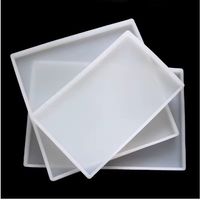
When you're starting out in epoxy work, silicone molds seem like the obvious choice. They're cheap, they're everywhere, and the product photos look great. But here's what those photos don't show you: what happens after you pour 15 kilos of slow-cure epoxy into a silicone mold and walk away for 48 hours.
The base flexes. Not dramatically — just a few millimeters. But a few millimeters across a 70-inch dining table is the difference between a flat surface and one that rocks on the floor. You don't notice it until the piece is cured, demolded, and sitting on your client's kitchen floor. That's a bad moment.
I've had silicone molds stretch at the corners. I've had them leak at the seams when the resin heats up during exotherm. I've had pigments from previous pours contaminate a fresh casting because the silicone absorbed them. Every one of those problems costs time, money, and materials.
The worst part is that none of these are defects. That's just what silicone does at scale.
What Makes HDPE Different
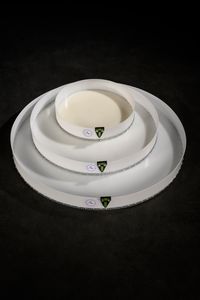
HDPE — High Density Polyethylene — is the material we use for our molds, and the difference isn't subtle. Where silicone flexes, HDPE holds. Where silicone absorbs, HDPE releases. Where silicone degrades after heavy use, HDPE looks the same on pour number two hundred as it did on pour number one.
Here's what that means in practice.
Flatness. An HDPE base doesn't bow under the weight of a full epoxy pour. The bottom of your casting comes out flat — genuinely flat, not "flat enough if you sand it for an hour." For furniture work, this is non-negotiable. A dining table that wobbles is a dining table your client sends back.
Dimensional accuracy. When you build a mold to 95 inches by 48 inches, it stays 95 inches by 48 inches. Silicone stretches under load — sometimes by half an inch or more across a large pour. Over time it stretches permanently. Your 70-inch mold becomes a 71-inch mold, and you don't realize it until you're trying to fit a tabletop into a frame that was cut to spec.
Clean release. HDPE is naturally non-stick to epoxy. You don't need release agents, wax, or anything else. The cured piece just comes out. Silicone is also non-stick in theory, but cheaper silicone formulations grip more than they should — especially with pigmented or filled resins — and you end up with torn edges or surface texture transferred from a mold that's seen better days.
Durability. HDPE doesn't degrade from UV exposure, chemical contact, or repeated use. It doesn't absorb moisture. It doesn't crack. A quality HDPE mold is genuinely a one-time purchase. I have molds that have been used weekly for three years and they perform exactly as they did on day one.
No contamination. Silicone — especially cheaper silicone — absorbs colorants. If you've poured a deep ocean blue and then try to pour a clear casting in the same mold, you may find your "clear" has a blue tint. HDPE doesn't absorb anything. Each pour starts completely clean.
The Size Problem with Silicone
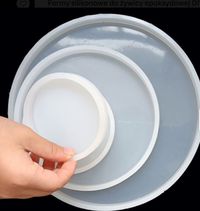
This is where the comparison becomes almost unfair. Silicone molds for epoxy work top out at relatively small sizes — useful for coasters, small decorative pieces, maybe a small coffee table if you're lucky. But a full dining table? A conference table? A kitchen island?
Silicone simply can't hold its shape at those dimensions. The larger the mold, the more the base flexes, the more the walls bow outward under hydrostatic pressure from the resin. You'd need an elaborate external support frame to even attempt a large pour in silicone — at which point you've already spent more money and time than a proper HDPE mold would have cost.
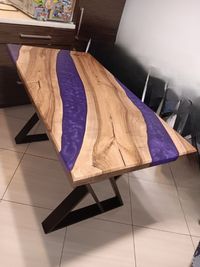
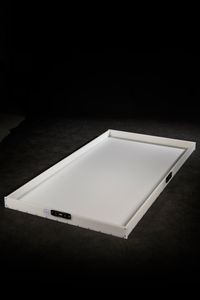
Our HDPE molds go up to 95 inches by 48 inches as a standard size — that's an 8-foot by 4-foot casting surface, enough for a substantial conference table or a large river table that seats ten people comfortably. We also make custom sizes for projects that go beyond even that. No silicone manufacturer offers anything close to this, because the material simply won't cooperate at that scale.

The Real Cost Calculation
Silicone molds look cheaper upfront. A silicone mold for a 48-inch table might cost a fraction of an equivalent HDPE mold. But let's look at what silicone actually costs over time.
A typical silicone mold for large pours degrades noticeably after 20 to 30 uses — stretching, tearing at stress points, losing its non-stick properties. So you're replacing it every few months if you're working regularly. Each replacement costs money. Each failure during a pour — a leak, a warped base, a contaminated casting — costs significantly more in wasted resin and materials.
An HDPE mold, used weekly, should last years without any degradation. The upfront cost is higher. The lifetime cost is substantially lower. And the quality of output is consistently better throughout.
For hobbyists doing occasional pours, the math might look different. But for anyone running a workshop, taking client commissions, or producing furniture seriously — HDPE isn't a luxury. It's just the correct tool for the job.
What to Look for in an HDPE Mold
Award-winning and locally-produced
Not all HDPE molds are created equal. Here's what separates a well-made mold from one that will disappoint you.
Wall and base thickness. Thinner HDPE will flex more, defeating the purpose. Look for at least 10mm thickness on standard molds, and 12mm or more on larger formats where rigidity is critical. Our large molds use 12mm HDPE throughout for exactly this reason.
Leveling system. A built-in spirit level and adjustable feet are not optional extras — they're essential. Epoxy finds its own level, which means if your mold isn't level, your casting won't be either. Every mold we make ships with a bubble level and adjustable feet as standard.
Seam quality. Look at how the corners and joints are constructed. A well-built HDPE mold has tight, properly sealed joints that won't leak even under the pressure of a large, deep pour. Before each use, a bead of silicone sealant along the interior joints adds an extra layer of security — allow 48 hours to cure before pouring.
Size range. A manufacturer that only offers small standard sizes may be fine for hobby work but won't grow with you. Look for someone who offers large formats and custom sizing.

One Last Thing
I started making HDPE molds because I was frustrated with the alternatives. What I've found, working with makers around the world — we ship to over 70 countries — is that the frustration is universal. Every experienced epoxy worker I talk to has a silicone disaster story. Most of them have switched, or are planning to.
The learning curve in epoxy work is steep enough without fighting your equipment. Use a mold that works with you, not against you.
If you have questions about sizing, specifications, or custom orders, reach out. I'd rather spend ten minutes helping you choose the right mold than have you discover the hard way that you chose the wrong one.